Blog · Batch 04
Sentiment Landscape Exploration on Social Media During the Thailand–Cambodia Tension #4 (10–23 Jul 2025)
Sentiment Landscape Exploration on Social Media During the Thailand-Cambodia Tension (Batch #4) collected data between July 10 and 23, 2025, gathering a total of 28,298 posts from the X platform. Data collection during this period focused on tracking reactions and narratives reflecting emotions, unfolding events, and the responses of various sectors to the continuously evolving border situation.
Message Over Time
Key Events During the Data Collection Period
- 13 July
- Cambodia's former Prime Minister Hun Sen posted a claim that Thailand had accepted the 1:200,000 scale map referenced in the 2000 Memorandum of Understanding on the Survey and Demarcation of the Land Boundary ("MOU43"), while also rallying public sentiment in Cambodia through a display of patriotic songs and a show of military force.
- A Cambodian woman violated a photography ban by displaying the Cambodian national flag at Prasat Ta Muen Thom.
- Thai civil society groups mobilized, with political groups calling on the government to take the Thailand-Cambodia border dispute more seriously.
- GunJompalang, a Thai social media personality, began a livestream campaign targeting Cambodian beggars operating in Thailand.
- 14 July
- Cambodian Prime Minister Hun Manet announced three conditions for reopening the border crossings: Thailand must reopen the crossings and guarantee it would not close them again, all crossings must reopen without exception, and crossings must operate on a fixed daily schedule from 6:00 AM to 10:00 PM.
- On the Thai side, a former Thai ranger volunteer punched a Cambodian soldier in an altercation at Prasat Ta Muen Thom.
- A wave of criticism spread on Thai social media alleging that Thailand had failed to object when Cambodia registered Thai literary works with UNESCO back in 2008.
- 15 July
- Cambodia announced plans to increase its defense budget and introduce mandatory military conscription starting next year.
- Continued unrest occurred at Prasat Ta Muen Thom, including an incident of Cambodian visitors provoking Thai soldiers and a separate incident involving a female tourist confronting Thai troops.
- The Royal Thai Army stated that Cambodia had repeatedly violated existing border agreements, citing as its latest example the construction of a cable car and staircase up Phu Makhuea.
- Maris Sangiampongsa, Thailand's Minister of Foreign Affairs, prepared to invite Cambodia to a Joint Boundary Committee (JBC) meeting in September, while reaffirming that Thailand would not respond to Cambodia through social media.
- Thailand's Deputy Minister of Defence denied reports that Thailand was preparing to construct a border fence.
- Thailand's Ministry of Culture issued a statement refuting claims that Cambodia had registered 22 Thai literary works with UNESCO, calling the reports inaccurate, while explaining the concept of shared cultural heritage within the region.
- 16 July
- Lt. Gen. Boonsin Padklang, Commander of the Royal Thai Army's Second Army Region, reported that Thai soldiers stepped on a landmine while on patrol near Hill 481, a disputed area close to Chong Bok in Nam Yuen district, Ubon Ratchathani province. Three soldiers were injured, though their conditions were reported as stable.
- 17 July
- The Second Army Region dispatched an explosive ordnance disposal unit to collect evidence and bring in specialists to determine whether the landmines were old remnants or newly planted devices, with results expected within three days.
- Former Prime Minister Thaksin Shinawatra criticized Cambodia's leadership as lacking ethics, in remarks widely understood as directed at Hun Sen, sparking a public exchange between the two.
- 19 July
- The Second Army Region announced the discovery of newly planted landmines at eight locations inside Thai territory, which it said violated the Ottawa Convention. Cambodia denied the allegation in an official letter, reaffirming its commitment to humanitarian principles.
- Thailand prepared to submit a formal report of the findings to the Royal Thai Army and the government, with plans to file a protest with the United Nations.
- The Facebook page "Army Military Force – สำรอง" published a video allegedly showing Cambodian soldiers holding a TM-57 anti-tank mine, reportedly preparing to plant it near the border. The footage had previously circulated on Cambodian social media before being taken down.
- 20 July
- Cambodia claimed that images circulating on Thai social media showed Thai soldiers planting the landmines themselves. It suggested that if Thailand wished to file a complaint against Cambodia with the United Nations, it should instead bring the case to the International Court of Justice (ICJ), noting that the ICJ is the UN's principal judicial body.
- 22 July
- Cambodia's Ministry of Foreign Affairs issued a statement rejecting accusations of planting landmines, calling the claims baseless and unsupported by evidence.
- The Royal Thai Army invited foreign military attachés to a briefing, reaffirming that newly planted landmines had been found inside Thai territory in violation of the Ottawa Convention.
- Rangsiman Rome, chair of the House Committee on National Security, Thai Border Affairs, National Strategy, and Country Reform, criticized the Thai government for responding too slowly to the situation.
- Cambodian Prime Minister Hun Manet warned Thailand against distorting facts and making accusations against Cambodia, saying such conduct was not befitting of a country with strong moral standing.
- Thailand's Cabinet approved an extension allowing Cambodian workers holding Border Pass documents to continue working in Thailand for an additional six months.
- Air Cambodia issued a statement addressing accusations that its aircraft livery and flight attendant uniforms resembled those of Thai Airways, confirming the resemblance was coincidental.
- 23 July
- Five Thai soldiers were injured by a landmine explosion in Nam Yuen district, Ubon Ratchathani province. One soldier had his right leg amputated as a result of the injury.
- The Royal Thai Army announced the closure of four border checkpoints and the permanent closure of two others, Ta Muen Thom and Ta Kwai. The Army also raised the readiness level of troops in the area to "combat preparedness."
- Thailand downgraded diplomatic relations with Cambodia to their lowest level, recalling its ambassador from Cambodia and expelling the Cambodian ambassador from Thailand in response to the landmine incident.
- Cambodia, in turn, also recalled its diplomatic officials from Thailand.
The period between July 10-23, 2025 marked a phase in which the Thailand-Cambodia border conflict intensified both geopolitically and online. Social media during this period functioned not merely as a space for communication, but as an arena that significantly amplified and drove public sentiment around the unfolding situation. Data collected and analyzed from online conversations reveals narratives and emotional reactions that rose and fell in waves, tracking key events day by day, as follows.
In the early part of the timeline (July 10-13), average daily posting volume remained below the overall period average, with July 12 recording the lowest volume at just 1,103 posts, reflecting a lull before tensions fully erupted. Online conversation began shifting direction on July 14 (1,867 posts), where, although no major border incident occurred directly on that day, signs of "accumulating unease" emerged among social media users, who began expressing dissatisfaction with the government's perceived silence or lack of clarity in communicating about the situation. Criticism of media outlets for ambiguous reporting, along with the sharing of videos and images of Cambodian activities, also gained more traction on that day.
A significant turning point in the online conversation occurred on July 15, when posting volume surged to 2,791. This spike coincided with a cluster of events that generated emotional ripples across multiple dimensions, including the Thai government's continued cautious posture, with security spokespersons affirming that Thailand would "not respond via social media" and that the border situation "remained unchanged," which many online users interpreted as indifference toward Cambodian provocation. Public discontent toward the government began to spread, with growing calls to "rise up and fight" or "respond decisively." At the same time, unrest occurred at Prasat Ta Muen Thom, particularly an incident in which a Cambodian woman openly confronted Thai soldiers, and rumors later circulated online that she was "a granddaughter of the late King Sihanouk," sparking broader debate over national dignity and cultural identity. The Thai online space reflected anger and a sense of being "trampled on," spanning political, cultural, and sovereignty dimensions. Rumors that Cambodia had proposed registering Thai literary works with UNESCO further reinforced a sense that Thailand was under continuous symbolic threat. These accumulated sentiments erupted into aggressive language, questioning of the government's role, and calls for clear policy or symbolic retaliation.
Between July 16-22, daily posting volume remained high, particularly during July 20-22, when reports emerged of Cambodia adopting a hardline stance toward Thailand on the international stage, while the Thai side issued statements attempting to de-escalate tensions. Meanwhile, the online public criticized this stance as "weak" or "lacking conviction," generating social pressure on the state to take action beyond a peace-oriented approach.
Posting volume peaked during this study period on July 23, reaching as high as 3,633 posts, reflecting a severe intensification of both emotional and situational tension. Major developments on that day spanned security, diplomacy, and public communication, particularly the injury of five Thai soldiers in a landmine explosion in Nam Yuen district, Ubon Ratchathani province, one of whom suffered a severe injury resulting in the loss of a leg. This incident was widely perceived as a grave violation of sovereignty and a breaking point in public tolerance, prompting the Royal Thai Army to respond immediately by closing four border checkpoints indefinitely and raising troop readiness to combat preparedness.
Around the same time, the Thai government took diplomatic countermeasures, downgrading relations with Cambodia to their "lowest level," announcing the recall of Thailand's ambassador from Cambodia and preparing to expel the Cambodian ambassador from Thailand, prompting a reciprocal response from the Cambodian government. This move came against the backdrop of Cambodia's recent statement on the international stage accusing Thailand of being the aggressor in the border dispute.
In addition, Thailand's Ministry of Digital Economy and Society, together with the Ministry of Foreign Affairs, held a press briefing on legal action against individuals spreading "fake news" about Thailand-Cambodia relations online, emphasizing that distorted content posed a threat to national security. This briefing sparked widespread criticism, with many users expressing dissatisfaction over what they viewed as the state using "fake news" as a pretext to restrict freedom of expression, particularly at a time when many members of the public wanted the government to respond with strength and decisiveness to the unfolding events. Feelings of anger, disappointment, and distrust were clearly visible across the online space.
The analysis of Batch 4 data found that the narratives could still be grouped into the same 10 main topics identified in previous batches, reflecting the continuity of the central issues driving online discussion. The details are as follows.
Emerged Topics
- Life and Humanity
- Discussions concerning the value of human life, livelihoods, everyday well-being, and the social and economic conditions of communities living along the Thailand–Cambodia border.
- Militarization
- Discussions related to military activities, including troop deployments, fortification of positions, border patrols, military confrontations, armed clashes, and the use or threat of force along the border.
- Domestic Politics
- Discussions in which the border dispute or Thailand's relations with Cambodia are used to criticize or discredit political opponents within Thailand.
- Sovereignty and Territorial
- Discussions emphasizing the protection of national territory, sovereignty, border demarcation, territorial claims, and the legitimacy of competing claims over disputed areas.
- Retaliatory Measures
- Discussions concerning reciprocal measures adopted by Thailand and Cambodia, such as border restrictions, suspension of electricity and internet services, trade controls, and other state-imposed countermeasures.
- Identity and Culture
- Discussions involving national identity, cultural disputes, rejection of shared cultural heritage, cultural superiority narratives, or derogatory representations of another nation's culture or identity.
- Peacebuilding
- Discussions advocating dialogue, diplomatic negotiations, conflict de-escalation, and non-violent approaches to resolving the dispute.
- Colonial Legacy and Historical Memory
- Discussions referring to historical events and narratives, including colonial-era border demarcation by France and the use of historical memory to justify contemporary territorial claims.
- Pro-War and Call for Violence
- Discussions expressing support for military action, armed retaliation, or the use of force to resolve the dispute.
- Legal Mechanisms
- Discussions concerning international legal and diplomatic mechanisms, including the International Court of Justice (ICJ), the Joint Boundary Commission (JBC), the 2000 Memorandum of Understanding (MOU 2000), and bilateral negotiations.
The topic of Life and Humanity remained the most prominent category of attention, appearing in 36.1% of all posts, reflecting how many users continued to discuss the impact on people in the affected areas, everyday livelihoods, and humanitarian dimensions, even as tensions between Thailand and Cambodia appeared to begin easing.
Meanwhile, the topic of Militarization ranked second, accounting for 19.68% of posts, reflecting continued discussion of the military's role and military-related developments, both along the border and at the policy level.
The topic of Domestic Politics appeared in 15.82% of posts, showing that domestic debate over the government's handling of the border situation continued, becoming a space for broader political criticism.
The topic of Sovereignty and Territorial Integrity also remained significant, accounting for 11.43%, reflecting the ongoing presence of debates over border rights, territorial claims, and national sovereignty within online narratives.
Analysis of sub-topics across all 10 main topics revealed that the online space during this period became an arena of intense narrative competition, in which the meaning of Thai national identity was continually dismantled and reconstructed through the collision of historical memory, emotion, and political imagination, with the border serving as the instrument and domestic conflict as the core. In other words, during the data collection period, the online space became an accelerant for emotional reactions that spread outward from interstate conflict into a collision of narratives and domestic politics, particularly as the border issue was weaponized as a measure of "patriotism" versus "treason." Domestic political figures such as Thaksin and Paetongtarn functioned as central actors within this arena of conflict, through the repeated construction of enemy images, both external and internal, reinforcing an increasingly crude "Us versus Them" emotional framework.
Although the border situation served as the trigger for this crisis, the sub-topics distributed across Domestic Politics and Identity and Culture demonstrate that the dynamics of this conflict did not arise from external events alone, but existed within a deeper structure of distrust toward state authority and the instability of Thai domestic politics itself. Recurring accusations of being a "traitor" or "disloyal" were not merely expressions of anger, but functioned as a process legitimizing a form of exclusionary nationalism.
A similar pattern appears in the content driving the topic of Retaliatory Measures, which points to an emotional slide from dissatisfaction toward calls for retaliation, whether through border closures, the suspension of cooperation, or even a degree of tolerance for the use of force, all of which became legitimized in the name of "protecting the nation."
However, amid this intensity of emotion and calls for hardline measures, efforts to push back against this current also appeared within the topics of Peacebuilding and Legal Mechanisms. Although low in volume, these topics reflected that a portion of the public still recognized the importance of peace mechanisms and international law. References to the Ottawa Convention, the Joint Boundary Committee (JBC) negotiation process, and cooperation under various memoranda of understanding pointed to an effort to carve out space for reason amid the tide of emotion.
Another notable dimension is the topic of Colonial Legacy and Historical Memory, which did not address the colonial era directly, but instead used narratives about the Thai state's failure to control the border area, or Cambodia's position as a hub of "transnational crime," as a vehicle for questioning the long-term authority and legitimacy of the Thai state.
Sentiment Distribution
The sentiment distribution within the dataset from July 10-23, 2025 showed that more than half of all posts (55.26%) fell into the Negative sentiment category, reflecting a tense emotional atmosphere across the online space. Neutral sentiment accounted for 40.53%, consisting of information, news, or commentary that did not clearly lean toward either side. Positive sentiment made up only 4.21%, an extremely low share indicating that hope, conciliatory voices, or positive emotion found almost no space online during this period.
Sentiment Distribution by Topic
Breaking sentiment down by topic, Negative sentiment appeared most intensely within Domestic Politics (66.35%) and Identity and Culture (63.31%). Both categories reflected anger, disappointment, and distrust directed more at domestic structures than at an "external enemy." This anger did not stem solely from the international conflict itself, but was intensified by a sense that the Thai government was "failing to act" or "failing to protect national interests," despite the government's consistent commitment to a peaceful approach.
However, as the border situation began to affect people's daily lives, particularly in humanitarian terms, such as border market closures, restricted trade, and disruptions to the travel and livelihoods of local workers and traders, online sentiment shifted in another direction, toward despondency and a sense that "ordinary people were bearing the consequences of a political game they had no part in." This is a notable emotional contradiction worth attention, as people called on the state to act "firmly," while also not wanting violence that would ultimately harm the public itself.
On the other hand, Sovereignty and Territorial and Militarization, categories one might expect to carry angry or hardline sentiment, instead showed higher-than-expected Neutral sentiment shares, at 49.16% and 55.07% respectively. Particularly notable is the topic of Pro-War Sentiment and Calls for Violence, which recorded an unusually high Positive sentiment level (17.88%), despite being a category centered on "calls for war." A closer look at the underlying data shows that "positive" sentiment in this context did not necessarily indicate hope or a desire for peace, but instead reflected agreement, pride, or a view that the use of violence was now an "appropriate" solution to the problem.
Meanwhile, the topic of Legal Mechanisms was the only category with Neutral sentiment approaching 90%, and the lowest Negative sentiment at just 6.25%, consistent with the role of law and international mechanisms, which tend to be discussed in factual rather than emotionally charged terms.
Hate Speech Distribution
- TYPE 1
- Cursing with vulgar words, insulting intelligence, and creating otherness
- TYPE 2
- Doxing and harassment, and intimidation
- TYPE 3
- Stereotyping, labeling, devaluing, dehumanizing, and demonizing
- TYPE 4
- Discrimination
- TYPE 5
- Incitement, glorification, support, legitimization, and representation of violence
The sentiment analysis found negative posts to be the largest category, totaling 15,638 posts. Examining this group through the lens of hate speech, most posts fell within Type 1 and Type 3, primarily targeting Cambodia and the Thai government as the main subjects. While both types are generally considered lower in severity, their prevalence signals a warning of a shift from "dissatisfaction" toward the "legitimization of violence."
Type 1 (insults, vulgar language, attacks on intelligence, and othering) was the most common, accounting for 61.41% of all negative posts, reflecting a state of hatred and anger directed at Cambodia, expressed through content spanning identity and culture, as well as border-related narratives. This type also included posts expressing anger and dissatisfaction toward the government and relevant agencies' handling of the situation, such as criticism of the response being too slow or insufficiently firm.
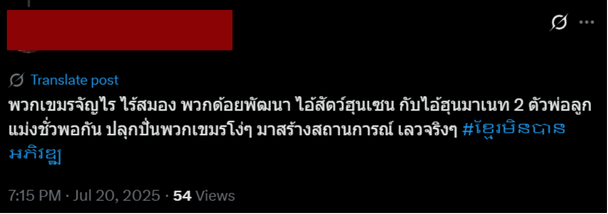
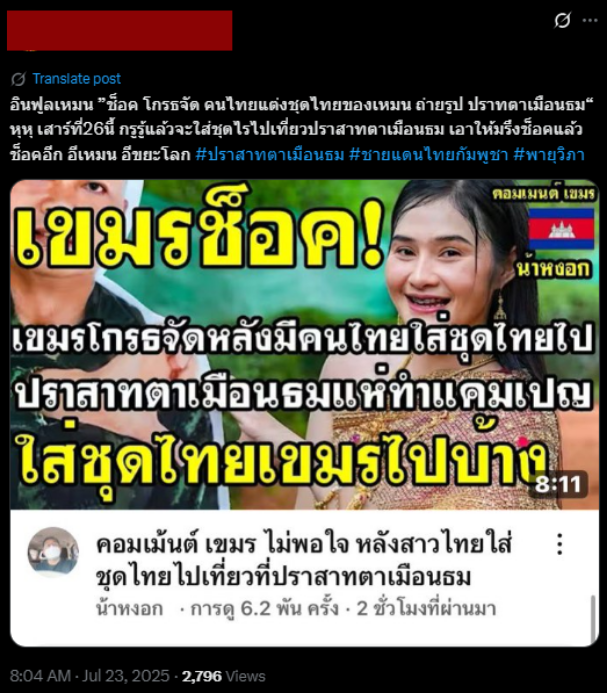
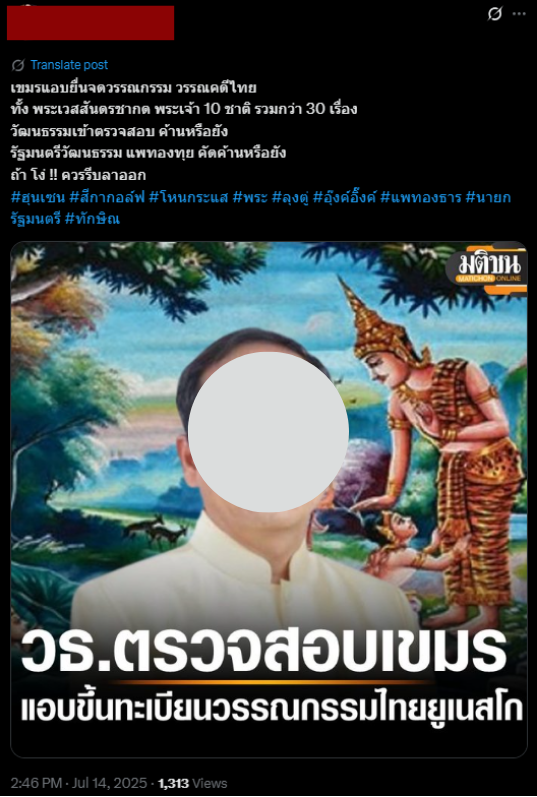
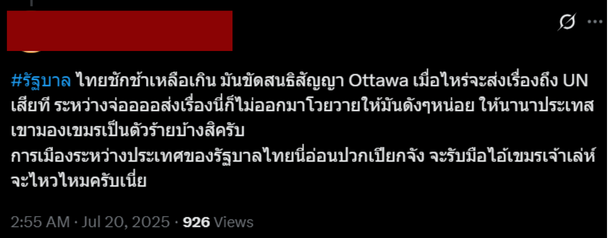
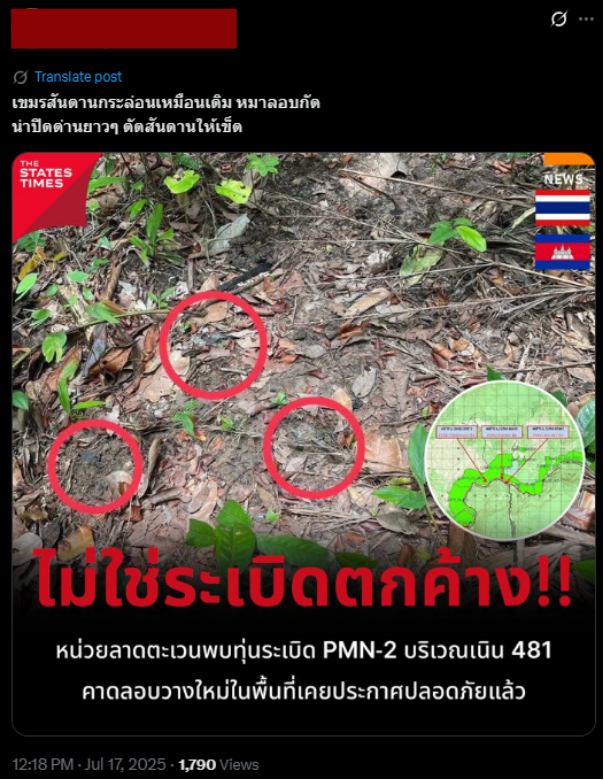
Type 3 (dehumanization, stereotyping, and labeling) followed at 31.00%, commonly manifesting as generalizations portraying Cambodians using derogatory Thai terms such as "กะล่อน" (deceitful/two-faced), "หมาลอบกัด" (a sneaking dog that bites, implying treachery), "โจร" (thief/bandit), and "เจ้าเล์ห์" (cunning/scheming), reinforcing and amplifying negative stereotypes of Cambodians and escalating the intensity of hatred at a societal level.
Type 4 (discrimination and exclusion) appeared at 5.40%, Type 2 (doxing and intimidation) at 1.56%, and Type 5 (incitement and glorification of violence) at 0.63%. Although these three types appeared in relatively low proportions, their presence signals a meaningful extremity within the broader tension, particularly in their connection to real-world violence.
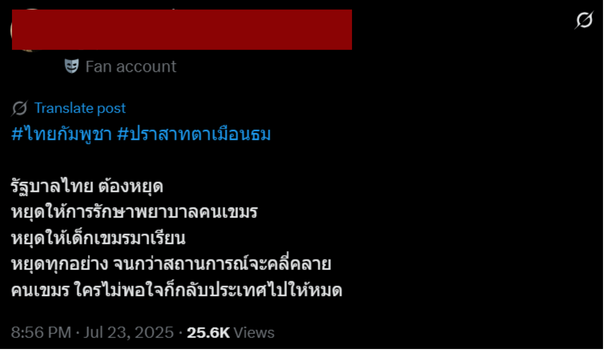
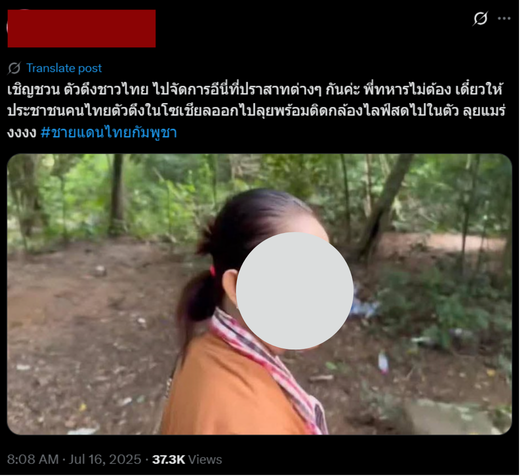
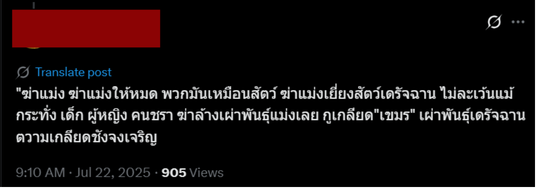
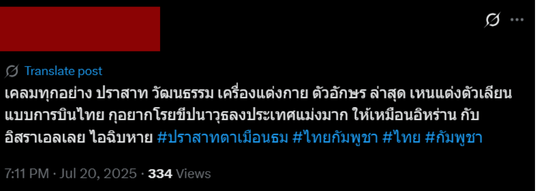
In summary, the concentration of hate speech within Types 1 and 3 points to a distinctive pattern of communication within this conflict crisis, in which anger and the construction of an enemy image serve as the primary mechanisms driving public sentiment. This pattern warrants particular attention in the development of tools or approaches for early warning systems aimed at detecting the escalation of violence in online spaces.
Top 10 Account by Post Count
Data on the Top 10 Accounts by Post Count showed that the accounts with the highest posting volume were all mainstream media outlets, such as @naewna_news (241 posts), @PPTVHD36 (223 posts), and @thaipost (183 posts), indicating that these media accounts played a significant role in producing content and feeding information into the online ecosystem during the border crisis. Notably, @thaipost, in addition to ranking among the top posters, also appeared among the Top 10 Accounts by Negative Sentiment, pointing to a tendency toward framing coverage in terms of security or nationalism that may have amplified negative public sentiment.
Top 10 Account with Most Mentions Other
Considering the accounts with the highest frequency of mentioning other users, general user accounts such as @Sixxxx, @Gixxxx, and @boxxxx appeared among the top accounts by mention activity, reflecting an active usage pattern that plays a role in raising issues or pushing particular ideas into the public sphere. Notably, @Gixxxx recorded a negative sentiment share as high as 13.48%, while @boxxxx stood at 10.68%.
Top 10 Account by Sentiment
In terms of sentiment, data on the accounts with the highest share of positive posts showed that general user accounts such as @Skxxxx, @mixxxx, and @UKxxxx recorded positive sentiment shares as high as 14-16%. Although these accounts did not rank among the highest in post volume or mention activity, their role within the online space resembled a kind of "quiet voice" helping to maintain emotional balance in a space otherwise dominated by tension.
Taken together, mainstream media accounts continued to dominate as content producers and agenda-setters within the information space, while general user accounts played a more varied set of roles, ranging from amplifiers of information to sources of emotional balance amid the conflict.
You can view the interactive dashboard at neomomentum.co/c-map