Blog · Batch 02
Sentiment Landscape Exploration on Social Media During the Thailand–Cambodia Tension #2 (12–25 Jun 2025)
Sentiment Landscape Exploration on Social Media During the Thailand–Cambodia Tension (Batch #2) collected user comments from the X platform between June 12 and 25, 2025, using relevant keywords. The data collection identified a total of 57,709 posts related to the tension between the two countries.
Message Over Time
Key Events During the Data Collection Period
- 12 June
- Hun Manet, Prime Minister of Cambodia, ordered a halt to Cambodia's purchases of electricity and internet services from Thailand and banned the broadcast of all Thai films, part of a broader set of retaliatory measures amid the border dispute.
- Thailand's Ministry of Interior instructed provincial governors in border areas to survey bomb shelters, rehearse civilian evacuation plans, and prepare vehicles near high-risk zones.
- Thailand's Ministry of Foreign Affairs reaffirmed three principles guiding its approach to the Joint Boundary Committee (JBC) negotiations: easing tensions, achieving a clear and mutually recognized border demarcation, and protecting Thai territory without any concession.
- Thailand's Burapha Task Force, the military unit responsible for the eastern border region, limited the number of vehicles permitted to cross at the Aranyaprathet checkpoint.
- The House Committee on National Security, Thai Border Affairs, National Strategy, and Country Reform invited security agencies to discuss strategy ahead of the JBC meeting.
- French President Emmanuel Macron offered to help facilitate the exchange of evidence between the two countries in support of the dispute resolution process, a reference to competing historical and cartographic claims over the border.
- 14-15 June
- Thailand and Cambodia held a meeting of the Joint Boundary Committee (JBC), the bilateral body responsible for demarcating and resolving disputes along their shared border.
- 16 June
- Hun Manet referred four disputed border areas to the International Court of Justice (ICJ) for adjudication, a move Thailand has consistently rejected as it does not recognize the court's jurisdiction over the dispute.
- Hun Sen, Cambodia's former Prime Minister, President of the Senate, and a dominant figure in Cambodian politics, issued an ultimatum demanding Thailand reopen all border checkpoints within 24 hours, warning that Cambodia would otherwise close its own checkpoints and ban imports of Thai goods.
- Thailand's Prime Minister convened a meeting with relevant government agencies to review the outcome of the JBC talks.
- Thailand's Ministry of Foreign Affairs stated that the JBC meeting had not discussed the ICJ or the 1:200,000 scale map, as Cambodia had claimed, and reiterated that Thailand does not accept the ICJ's jurisdiction over the matter.
- Some Cambodian workers began returning home through the Chong Chom border crossing in Surin province, while Thailand's Minister of Labour reaffirmed that there was no policy to deport Cambodian workers.
- The Pheu Thai Party, the leading party in Thailand's ruling coalition, reaffirmed its "Path of Peace" approach, emphasizing support for peaceful resolution and regional stability.
- 18 June
- Hun Sen released a nine-minute audio clip of a private phone call he had with Prime Minister Paetongtarn Shinawatra on June 15, in which the two discussed the border situation.
- Hun Many, Cambodia's Deputy Prime Minister and President of the Union of Youth Federations of Cambodia, led a rally in support of the Cambodian government's measures on the border dispute.
- Amid rumors that Cambodia would not attend the Regional Border Committee (RBC) meeting, Deputy Prime Minister and Defence Minister Phumtham Wechayachai clarified that Thailand had not closed the border crossings but had only limited their opening hours, and stated that reports of Cambodia's non-attendance at the RBC meeting were a misunderstanding.
- 19 June
- Cambodia abruptly closed the Chong An Ma border trade point in Nam Yuen district, Ubon Ratchathani province, without prior notice, barring civilians from crossing in either direction.
- Prime Minister Paetongtarn Shinawatra issued a public apology over the leaked phone call, warning that it risked creating division, and reaffirmed her unity with the armed forces. Thailand's Ministry of Foreign Affairs summoned the Cambodian ambassador to lodge a formal protest, stating that the leak of the call between Paetongtarn and Hun Sen violated diplomatic norms.
- The Chanthaburi-Trat Border Defense Command (CTBDC) announced a ban on drone flights over government and restricted areas, citing national security concerns.
- The Senate and its Military and Security Committee issued a statement calling for the Prime Minister's resignation. Protesters from the Thailand Reform Network of Students and People (༬༹༹.), together with the Senate's Military Committee, pressured the Prime Minister to resign and petitioned the Constitutional Court and the National Anti-Corruption Commission (NACC), alleging serious ethical misconduct.
- Political parties' positions shifted. The Bhumjaithai Party withdrew from the governing coalition. The Palang Pracharath, United Thai Nation, and Thai Sang Thai parties issued statements calling for the Prime Minister's resignation. The People's Party called for the dissolution of Parliament, while the Pheu Thai Party declared its support for a peaceful approach, invoking its "Path of Peace" stance to preserve national sovereignty.
- 22 June
- Cambodia faced a fuel shortage and rising prices, following earlier restrictions on fuel exports from Thailand, prompting Cambodian residents to cross into Thailand to refuel.
- The Pheu Thai Party reaffirmed that the Prime Minister would neither resign nor dissolve Parliament.
- 23 June
- Cambodian Prime Minister Hun Manet declared that Cambodia's border closures would remain permanent and that Cambodia would not join any talks or negotiations, including the Joint Boundary Committee (JBC), until Thailand reopened all border crossings.
- Prime Minister Paetongtarn Shinawatra chaired a meeting on combating transnational crime, describing Cambodia as "the world's largest hub of cybercrime."
- The Prime Minister announced tough new measures, cutting internet, electricity, and fuel supplies and barring border crossings in an effort to crack down on "scam gangs."
- The Royal Thai Army ordered tighter controls on entry and exit at 6 permanent checkpoints and 10 border trade points along the entire Thailand-Cambodia border.
During this period, a total of 57,709 posts were related to the tension between the two countries. The volume remained consistently high, continuing the trend from earlier in June. This began on June 12, 2025, when the Cambodian government announced a halt to imports of electricity, internet services, and entertainment media from Thailand, while Thai authorities took a firm public stance on protecting national sovereignty through press statements and high-level policy meetings. Posting volume peaked on June 18, 2025, driven both by the leak of a private phone call between the two countries' political leaders and by mobilization among Cambodian youth groups rallying in support of their government.
Between June 19-21, 2025, the situation within Thailand shifted significantly, as the fallout from the leaked call fueled domestic political pressure closely tied to the border dispute. This turned the X platform into a space for domestic political debate running alongside the international dispute. At the same time, humanitarian dimensions also emerged, such as the temporary reopening of a border crossing to allow Cambodian patients through for emergency medical care.
Retaliatory measures between the two governments became more pronounced between June 23-25, 2025, after the Cambodian government announced it would permanently close its border crossings and would not join talks with Thailand until all crossing points were reopened simultaneously. On the Thai side, the Prime Minister ordered an escalated crackdown on transnational crime. These developments generated a wide range of posts on social media, including questions about the Thai government's decisions, criticism of Cambodia's measures, and concerns about the impact on people living on both sides of the border.
The analysis of the Batch 2 data found that the narratives could still be grouped into the same 10 core topics identified in Batch 1, reflecting the continuity of the central issues driving online discussion. However, as the Thailand-Cambodia border tension intensified and broadened during the Batch 2 period, each topic carried more depth than before, with conversations branching into a greater number of sub-topics.
Emerged Topics
- Life and Humanity
- Discussions concerning the value of human life, livelihoods, everyday well-being, and the social and economic conditions of communities living along the Thailand–Cambodia border.
- Domestic Politics
- Discussions in which the border dispute or Thailand's relations with Cambodia are used to criticize or discredit political opponents within Thailand.
- Sovereignty and Territorial
- Discussions emphasizing the protection of national territory, sovereignty, border demarcation, territorial claims, and the legitimacy of competing claims over disputed areas.
- Militarization
- Discussions related to military activities, including troop deployments, fortification of positions, border patrols, military confrontations, armed clashes, and the use or threat of force along the border.
- Retaliatory Measures
- Discussions concerning reciprocal measures adopted by Thailand and Cambodia, such as border restrictions, suspension of electricity and internet services, trade controls, and other state-imposed countermeasures.
- Peacebuilding
- Discussions advocating dialogue, diplomatic negotiations, conflict de-escalation, and non-violent approaches to resolving the dispute.
- Identity and Culture
- Discussions involving national identity, cultural disputes, rejection of shared cultural heritage, cultural superiority narratives, or derogatory representations of another nation's culture or identity.
- Legal Mechanisms
- Discussions concerning international legal and diplomatic mechanisms, including the International Court of Justice (ICJ), the Joint Boundary Commission (JBC), the 2000 Memorandum of Understanding (MOU 2000), and bilateral negotiations.
- Colonial Legacy and Historical Memory
- Discussions referring to historical events and narratives, including colonial-era border demarcation by France and the use of historical memory to justify contemporary territorial claims.
- Pro-War and Call for Violence
- Discussions expressing support for military action, armed retaliation, or the use of force to resolve the dispute.
The topic of Life and Humanity appeared in the highest proportion (28.24%), reflecting how issues of daily life, livelihoods, and interpersonal relations between the two countries' populations remained central to online attention. Prominent sub-topics included narratives of hatred and stereotyping directed at Cambodians, discussions of migrant workers, and narratives linking Cambodia to transnational crime networks such as call center scam gangs.
The topic of Domestic Politics followed closely (27.09%), reflecting how the border tension was discussed not merely as an international issue but as a lightning rod for intense domestic political conflict. The "selling out the nation" narrative was one of the dominant frames, expressed through terms such as "traitor" and "sellout." Attacks were also frequently directed at Prime Minister Paetongtarn Shinawatra specifically on the grounds of her being a woman, with a recurring narrative portraying female leadership as inherently unfit to handle a national security crisis or wartime-like conditions. These attacks reflected severe misogyny, reducing her leadership and competence to her gender rather than her actions or decisions.
The topic of Sovereignty and Territorial Integrity ranked next (13.18%), reflecting anxiety and heightened emotional intensity online, particularly narratives glorifying the military's role in defending national sovereignty, alongside the construction of an adversarial narrative that cast Cambodian leaders such as Hun Manet and Hun Sen as figures actively threatening Thai sovereignty.
The topic of Militarization accounted for 11.64% of posts, reflecting the multiple roles and images associated with the military, ranging from narratives portraying soldiers as "guardians of sovereignty" to sub-topics linking the military to Thailand's history of coups, such as the hashtag "#ไม่เอารัฐประหาร" (#NoMoreCoup).
The topic of Retaliatory Measures made up approximately 7.43%, covering discussions of border crossing closures and reopenings, as well as claims of Cambodia cutting off electricity and internet access. Even though the Cambodian government denied taking such measures, these narratives were often framed as retaliatory actions reflecting public discontent.
The topic of Peacebuilding accounted for 5.88%, covering discussions around non-violent efforts to de-escalate tensions, with an emphasis on negotiation, respect for humanitarian principles, and safeguarding the lives and dignity of the people on both sides.
The topic of Identity and Culture, though comprising a smaller share (3.46%), carried strong emotional intensity, featuring the use of vulgar language and ethnic slurs such as the hashtag "#scambodia," alongside a cultural dispute over Muay Thai.
The topic of Legal Mechanisms made up only 1.31%, focused on references to international legal frameworks such as the International Court of Justice (ICJ) and the Joint Boundary Committee (JBC), functioning as a kind of "counterweight" within an online space otherwise dominated by inflammatory or emotionally charged political narratives.
The topic of Colonial Legacy and Historical Memory accounted for just 1.26%, reflecting narratives rooted in historical memory, particularly the ICJ's 1962 ruling on the Preah Vihear Temple dispute, the so-called "1:200,000 scale map" controversy, and a separate dispute over Wat Phu Man Fah, a Thai temple in Buriram province accused by Cambodian officials of replicating the architecture of Angkor Wat.
The topic of Pro-War and Call for Violence, while the smallest in share (1.21%), carried significant emotional weight. Content in this category did not consist of direct calls for war, but rather implicit justifications for the use of force, framed under the banner of "defending national sovereignty."
Sentiment Distribution
When examining the sentiment distribution within the dataset from June 12-25, 2025, the overall sentiment of posts in Batch 2 continued to skew predominantly negative. Posts classified as Negative accounted for as much as 60.5%, while Neutral posts stood at 34.7% and Positive posts made up only 4.8%. Although there were slight signs of a broader distribution of sentiment compared to the previous batch, negative sentiment remained the dominant force driving the online space.
Sentiment Distribution by Topic
The topics of Identity and Culture and Domestic Politics showed negative sentiment exceeding 77%, the highest rate among all categories, reflecting a Politics of Emotion driven by anger and the construction of a "common enemy."
By contrast, topics tied to institutional mechanisms, such as Legal Mechanisms, where Neutral posts reached 70.12%, and Peacebuilding, which recorded the highest share of Positive posts in this dataset (13.87%), suggest that structural or institutional communication still holds space to shift user sentiment toward de-escalation. The topic of Pro-War and Call for Violence, despite its low overall volume, showed a notably high proportion of Positive sentiment (12.17%) toward the use of force, a figure worth close attention.
Hate Speech Distribution
- TYPE 1
- Cursing with vulgar words, insulting intelligence, and creating otherness
- TYPE 2
- Doxing and harassment, and intimidation
- TYPE 3
- Stereotyping, labeling, devaluing, dehumanizing, and demonizing
- TYPE 4
- Discrimination
- TYPE 5
- Incitement, glorification, support, legitimization, and representation of violence
Following the sentiment analysis, negative posts emerged as the largest category, totaling 35,993 posts.
Type 1 (Cursing, Insulting Intelligence, Otherness) remained the largest share at 71.56%, comprising abusive and vulgar language, insults directed at intelligence, and the construction of otherness between groups, particularly directed at Cambodians.
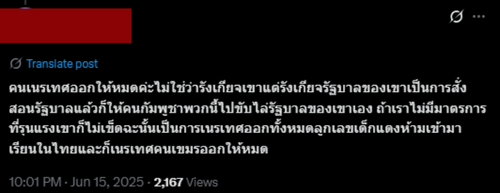
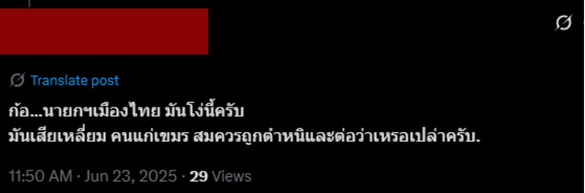
Following closely, Type 3 (Stereotyping, Labeling, Dehumanizing) appeared at a similarly high share of 23.19%, manifesting as stigmatization and generalization, constructing stereotypes that undermine the dignity of the targeted group.
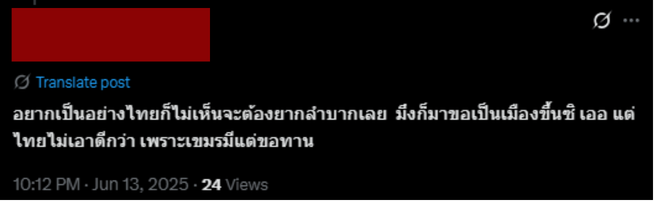
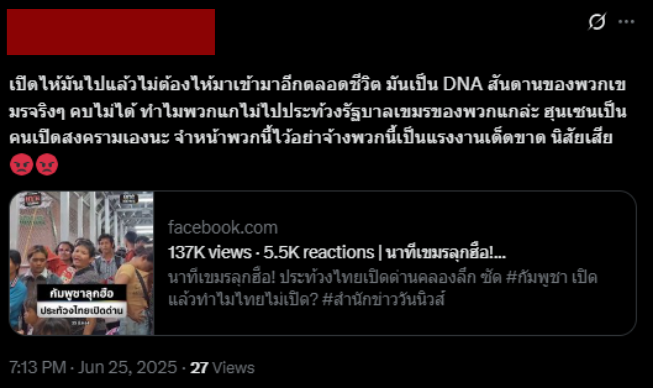
Type 4 (Discrimination) appeared next at 3.43%, consisting of posts expressing division or discriminatory treatment based on ethnicity.
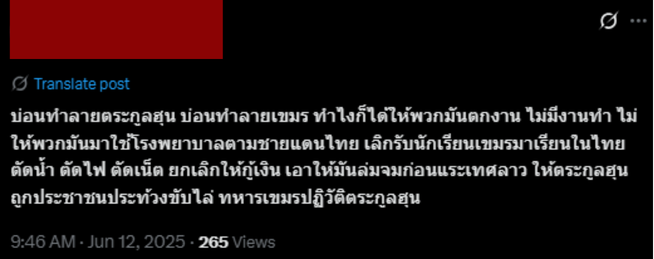
Type 2 (Harassment, Doxing, Intimidation) accounted for 1.46%, involving the identification of individuals, harassment, or intimidation. Finally, Type 5 (Incitement, Glorification of Violence) made up just 0.36%. Despite its small share, content in this category carries high sensitivity, as it directly legitimizes the use of violence.
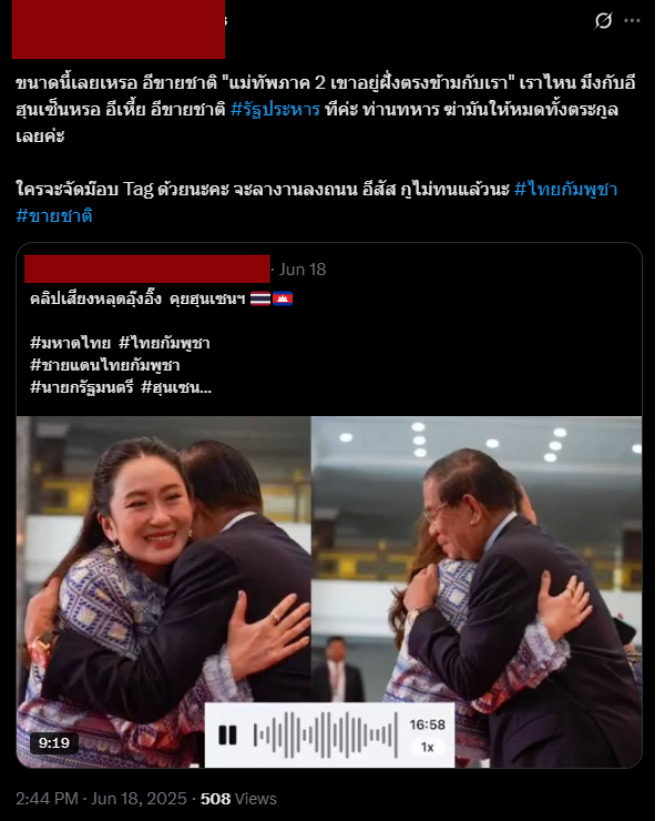
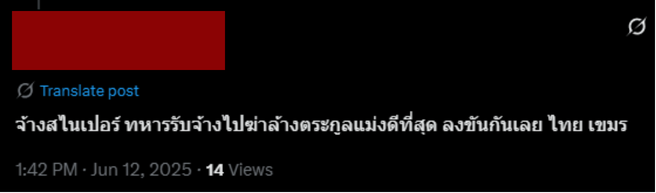
In summary, the hate speech analysis of Batch 2 points to the persistence and spread of language reflecting hatred at varying levels of intensity, deeply rooted in and closely tied to perceptions of a "common enemy" and the intense framing of "national defense."
Top 10 Account by Post Count
The accounts with the highest content production were mainstream media accounts such as @ThaiPBSNews (423 posts), @naewna_news (377 posts), @PPTVHD36 (369 posts), and @MatichonOnline (272 posts). In addition, several general user accounts with unusually high posting volumes were identified, such as @xixxxx and @baxxxx, who may be functioning as micro-influencers in this specific role.
Top 10 Account with Most Mentions Other
The account @boxxxx recorded the highest number of mentions of other users, totaling 231 instances, followed by @Lixxxx (146 instances) and @Zaxxxx (132 instances). This pattern reflects users who play an active, interactive role, whether through targeting others, engaging in arguments, or driving networked mobilization.
Top 10 Account by Sentiment
Among positive-sentiment posts, the account @baxxxx recorded the highest share of positive content (14.69%), followed by @KhaosodOnline (12.8%) and @naewna_news (12.32%). The researcher notes that content classification for the account @RTARF_PR, the public relations office of the Royal Thai Armed Forces, may have been interpreted by the large language model (LLM) as positive due to its use of morale-boosting language, such as the hashtag "#ไทยนี์รักสงบแต่ถึงรบไม่ขลาด" ("This land loves peace, but is not cowardly in war"). However, from the researcher's standpoint, content of this nature should be considered as communication that reinforces structural violence or nationalist narratives, rather than content that promotes an atmosphere of peace.
By contrast, the accounts @stxxxx and @baxxxx were classified with high shares of negative content, at 17% and 16.5% respectively. Among accounts producing predominantly neutral content, most were mainstream media outlets, such as @ThaiPBSNews (16.15%), @PPTVHD36 (13.38%), and @MorningNewsTV3 (10.36%).
Nonetheless, mainstream media played a critical role in shaping the direction of public sentiment, particularly in cases where they reported on or translated the personal posts of public figures, such as former Prime Minister Hun Sen. This contributed to the spread of rumors, misunderstandings, and public backlash online, to the point where several Thai government agencies had to issue daily clarifications or corrections.
You can view the interactive dashboard at neomomentum.co/c-map