Blog · Batch 01
Sentiment Landscape Exploration on Social Media During the Thailand–Cambodia Tension #1 (13 May–11 Jun 2025)
The first batch of the Sentiment Landscape Exploration on Social Media During the Thailand–Cambodia Tension (Batch #1) collected posts from users on the X platform between May 13 and June 11, 2025, using a set of relevant keywords. The data collection identified a total of 49,127 posts related to the tensions between Thailand and Cambodia.
Message Over Time
Key Events During the Data Collection Period
- 18 May
- Cambodian troops advanced into Hill 745, a strategic hill in the disputed border area between Thailand and Cambodia near Chong Bok, and established a temporary military position before withdrawing following negotiations with Thai authorities.
- 28 May
- A brief armed confrontation occurred between Thai and Cambodian troops in the Chong Bok area, a disputed section of the Thailand–Cambodia border in Ubon Ratchathani Province. The incident resulted in the death of one Cambodian soldier and marked the most serious military confrontation between the two countries in more than a decade.
- 2 June
- Thailand's parliamentary opposition launched a no-confidence initiative against Prime Minister Paetongtarn Shinawatra, increasing domestic political pressure on the government over its handling of the border dispute.
- Natthaphong Ruengpanyawut, leader of the People's Party, stated that Thai military personnel had acted professionally and exercised restraint despite repeated provocations. He questioned whether the government had demonstrated the same level of professionalism.
- Kannavee Suebsang, a Member of Parliament from the Fair Party, declared that Thailand should not lose "even one square millimeter" of its territory. He argued that while the executive branch appeared weak, the legislature had a responsibility to provide stronger oversight.
- Prime Minister Paetongtarn Shinawatra and Deputy Prime Minister and Defence Minister Phumtham Wechayachai postponed plans to close border checkpoints, citing the need for careful consideration after Cambodia raised concerns about the economic consequences for border communities.
- 3 June
- Rangsiman Rome, Chair of the House Committee on National Security, Border Affairs, National Strategy, and National Reform, proposed a "Ten-Point Strategy for Winning Without War" as an alternative framework for resolving the Thailand–Cambodia border dispute through diplomacy, international engagement, and strategic statecraft rather than military escalation.
- 5 June
- Cambodia declined to include the Chong Bok border dispute and disputes involving three ancient temple sites in the agenda of the Joint Boundary Commission (JBC) meeting. Instead, the Cambodian government announced its intention to refer the disputes to the International Court of Justice (ICJ).
- The Royal Thai Army launched an online communication campaign under the hashtag "#ไทยนี์รักสงบแต่ถึงรบไม่ขลาด" (#ThailandLovesPeaceButIsNotAfraidToFight), while civil society organizations and peace advocates promoted alternative hashtags including #NoWarThaiCambodia and "#สันติสู่ชายแดน"(#PeaceForTheBorder), reflecting competing narratives on social media regarding the appropriate response to the crisis.
- 6 June
- Deputy Prime Minister and Defence Minister Phumtham Wechayachai confirmed that the Joint Boundary Commission (JBC) meeting would proceed as scheduled despite Cambodia's decision to exclude several disputed issues from the official agenda.
- 7 June
- The Royal Thai Army introduced stricter border control measures, limiting cross-border movement to essential travel only.
- Phumtham Wechayachai disclosed that Thailand's proposals aimed at de-escalating tensions had been rejected by Cambodia, while military reinforcements continued to be deployed along the border by both sides.
- 8 June
- Thailand and Cambodia agreed to redeploy their troops to positions held in 2024, close the immediate confrontation area, and reduce military tensions in accordance with the 2000 Memorandum of Understanding (MOU2000) governing conduct along disputed sections of the border.
- The Thai military began implementing graduated cross-border control measures based on the evolving security situation.
- Cambodia reduced the permitted length of stay for Thai nationals entering the country via land border crossings to seven days and adjusted checkpoint operating hours to close one hour earlier than the corresponding Thai checkpoints.
- 9 June
- Thailand reduced the permitted length of stay for Cambodian nationals entering the country via land border crossings to seven days. The government also introduced additional border security measures, including suspending electricity and internet services supplied to casino complexes, strengthening controls on cross-border goods, and tightening oversight of military-related equipment moving through border areas.
- Cambodia denied reports that it had agreed to withdraw its troops, insisting that its forces would remain deployed in areas that Cambodia considers to be under its sovereign jurisdiction.
- 11 June
- Prime Minister Paetongtarn Shinawatra visited the Suranaree Task Force, the Thai military unit responsible for security along part of the eastern border, to monitor the situation. She instructed relevant agencies to coordinate the opening and closing of border checkpoints on schedule while emphasizing that the government would pursue a peaceful resolution to the dispute without compromising Thailand's sovereignty.
- Thailand and Cambodia agreed to allow students to cross the Khlong Luek border checkpoint before regular operating hours to minimize disruptions to their education.
- A Cambodian cabinet minister stated that Cambodia was no longer dependent on electricity imported from Thailand, asserting that domestic electricity supplies were sufficient to meet national demand.
- Economic activity in Poipet, the Cambodian border city opposite Thailand's Aranyaprathet district, slowed significantly as casino operations were disrupted. Many casinos laid off large numbers of employees, prompting many Thai workers to return to Thailand.
Social media activity increased markedly after 28 May 2025, when an armed confrontation between Thai and Cambodian military personnel was reported in the Chong Bok area of Ubon Ratchathani Province. The incident brought the border dispute back into the public spotlight. During the early stage of the observation period, posting activity remained relatively low and stable. However, the volume of posts began to rise steadily in late May before increasing sharply on 1 June, coinciding with the Thai Minister of Foreign Affairs' first official statement on the dispute. This marked the beginning of a more active phase of diplomatic engagement between the two governments.
The volume of posts reached its highest levels between 3 and 9 June, peaking on 4 June, when more than 6,000 posts were recorded in a single day. This surge coincided with several significant political and diplomatic developments, including the Cambodian National Assembly's endorsement of a proposal to refer the dispute to the International Court of Justice (ICJ) on 2 June, official statements issued by the Thai government on 4 and 5 June, and policy proposals from Rangsiman Rome, including his "Ten-Point Strategy for Winning Without War," which advocated resolving the dispute through diplomatic and non-violent means.
Social media activity on 5 June also reflected competing efforts to shape public opinion. The Royal Thai Army launched the hashtag campaign "#ไทยนี์รักสงบแต่ถึงรบไม่ขลาด" (#ThailandLovesPeaceButIsNotAfraidToFight), while civil society actors, including the activist group Thalugaz, promoted alternative peace-oriented campaigns under the hashtags #NoWarThaiCambodia and "#สันติสู่ชายแดน" (#PeaceForTheBorder). As a result, online discussions during this period became increasingly polarized, encompassing nationalist narratives, diplomatic proposals, and peace advocacy simultaneously.
Content analysis identified ten major narrative clusters, representing the principal themes discussed by social media users during the observation period.
Emerged Topics
- Life and Humanity
- Discussions concerning the value of human life, livelihoods, everyday well-being, and the social and economic conditions of communities living along the Thailand–Cambodia border.
- Domestic Politics
- Discussions in which the border dispute or Thailand's relations with Cambodia are used to criticize or discredit political opponents within Thailand.
- Sovereignty and Territorial
- Discussions emphasizing the protection of national territory, sovereignty, border demarcation, territorial claims, and the legitimacy of competing claims over disputed areas.
- Militarization
- Discussions related to military activities, including troop deployments, fortification of positions, border patrols, military confrontations, armed clashes, and the use or threat of force along the border.
- Peacebuilding
- Discussions advocating dialogue, diplomatic negotiations, conflict de-escalation, and non-violent approaches to resolving the dispute.
- Colonial Legacy and Historical Memory
- Discussions referring to historical events and narratives, including colonial-era border demarcation by France and the use of historical memory to justify contemporary territorial claims.
- Retaliatory Measures
- Discussions concerning reciprocal measures adopted by Thailand and Cambodia, such as border restrictions, suspension of electricity and internet services, trade controls, and other state-imposed countermeasures.
- Identity and Culture
- Discussions involving national identity, cultural disputes, rejection of shared cultural heritage, cultural superiority narratives, or derogatory representations of another nation's culture or identity.
- Legal Mechanisms
- Discussions concerning international legal and diplomatic mechanisms, including the International Court of Justice (ICJ), the Joint Boundary Commission (JBC), the 2000 Memorandum of Understanding (MOU 2000), and bilateral negotiations.
- Pro-War and Call for Violence
- Discussions expressing support for military action, armed retaliation, or the use of force to resolve the dispute.
The most prominent narrative cluster was Life and Humanity, accounting for approximately 48.47% of all posts. This indicates that public discussion was primarily centered on the everyday lives and well-being of people living in border communities. Conversations focused on personal safety, daily livelihoods, and the economic consequences of the escalating tensions. Many posts expressed feelings of uncertainty, anxiety, and fear regarding the potential impact of the conflict on local communities.
The Domestic Politics (15.27%) and Sovereignty and Territorial Integrity (15.19%) clusters also featured prominently. The former reflects how the border dispute became intertwined with Thailand's domestic political landscape, with users frequently using developments along the border to criticize or defend political actors. The latter captures expressions of concern over national sovereignty and territorial integrity, including assertions that Thailand should not make territorial concessions or surrender "even a single square inch" of its territory.
Although the Peacebuilding cluster represented a relatively modest 7.85% of all posts, it highlighted a distinct stream of discussion advocating de-escalation. Posts within this cluster emphasized bilateral dialogue, peaceful conflict resolution, adherence to diplomatic principles, and concern for the well-being of civilians in both Thailand and Cambodia.
The Pro-War and Calls for Violence cluster accounted for only 0.07% of all posts. Despite its limited prevalence, the cluster is noteworthy because it contained explicit support for military confrontation and the use of violence. While numerically small, such content warrants attention from policymakers and public communication practitioners due to its potential to reinforce narratives that legitimize violence during periods of heightened political tension.
Finally, the Retaliatory Measures (1.10%) and Legal Mechanisms (0.31%) clusters received comparatively little attention despite relating directly to official government responses and diplomatic processes. This suggests that discussions of formal policy measures, legal mechanisms, and institutional pathways for conflict resolution remained relatively limited in public discourse, pointing to a potential gap in public communication during the crisis.
Sentiment Distribution
The overall sentiment of the dataset was overwhelmingly negative. Negative posts accounted for 66.50% of all posts, while Neutral posts represented 27.43% and Positive posts comprised only 6.07%. The pronounced imbalance across these sentiment categories suggests that public reactions on social media were dominated by negative emotions, reflecting heightened tensions, dissatisfaction, anxiety, and anger surrounding the evolving Thailand–Cambodia border dispute.
Sentiment Distribution by Topic
The Life and Humanity cluster, which accounted for the largest share of all posts, also exhibited a high proportion of negative sentiment (68.53%). This suggests that although discussions within this cluster focused on people's livelihoods and well-being, they were predominantly framed through expressions of fear, uncertainty, and concern about the consequences of the border tensions.
The Domestic Politics cluster recorded the highest proportion of negative sentiment among all clusters, with 73.94% of posts classified as negative. This indicates that discussions linking the border dispute to Thailand's domestic political landscape were characterized by particularly strong negative emotional responses.
In contrast, the Peacebuilding cluster contained the highest proportion of positive sentiment, with 33.27% of its posts classified as positive. Posts within this cluster promoted dialogue, diplomatic engagement, international cooperation mechanisms, and concern for the well-being of civilians on both sides of the Thailand–Cambodia border.
Although the Pro-War and Calls for Violence cluster represented only a small share of the overall dataset, 65.31% of its posts expressed negative sentiment. This finding suggests that narratives advocating military confrontation were also accompanied by strong negative emotional expressions, underscoring the emotionally charged nature of calls for the use of force.
Hate Speech Distribution
- TYPE 1
- Cursing with vulgar words, insulting intelligence, and creating otherness
- TYPE 2
- Doxing and harassment, and intimidation
- TYPE 3
- Stereotyping, labeling, devaluing, dehumanizing, and demonizing
- TYPE 4
- Discrimination
- TYPE 5
- Incitement, glorification, support, legitimization, and representation of violence
Negative sentiment accounted for the largest share of the Batch 1 dataset, comprising 32,698 posts. A deeper analysis of these posts through the lens of hate speech revealed five distinct categories of harmful expression.
Type 1 was the most prevalent, accounting for 59.89% of all hate speech identified within negative posts. This category primarily consisted of abusive, insulting, and derogatory language directed at Cambodia, Cambodians, and individuals holding opposing political views.
The second most common category was Type 3 (32.71%), which captured narratives involving negative stereotyping, labeling, and dehumanizing portrayals of individuals or groups.
Type 4 accounted for 5.92% of cases and included expressions that promoted discrimination or exclusion based on national identity, ethnicity, citizenship, or other protected characteristics.
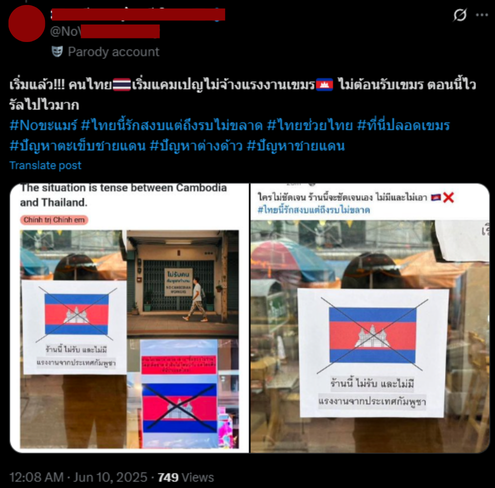
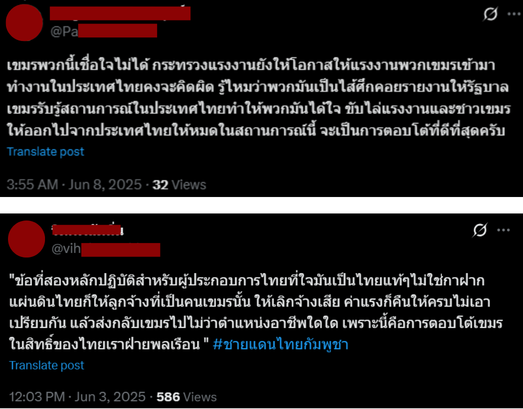
Type 5, while accounting for only 0.59% of identified hate speech, represents the most concerning category due to its potential to contribute to real-world harm. Posts in this category contained content that endorsed or encouraged violence, incited hostility, or portrayed the use of force as legitimate or necessary. Type 2 accounted for 0.89% of cases and consisted primarily of targeted harassment or abusive content directed at specific individuals.
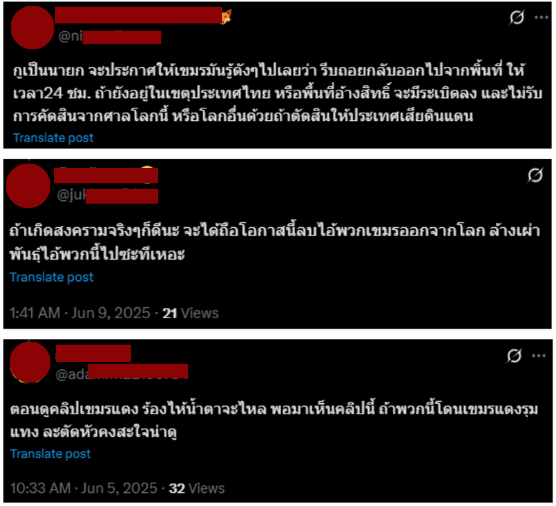
These findings suggest that the emotional escalation observed in online spaces during the Thailand–Cambodia border tensions extended beyond expressions of dissatisfaction or frustration. A substantial portion of negative sentiment evolved into various forms of hate speech, ranging from abusive language and dehumanizing narratives to discriminatory expressions and, in a small but significant number of cases, content endorsing violence. This pattern underscores the importance of continuous monitoring and timely responses to harmful online narratives during periods of heightened political and interstate tensions.
Top 10 Account by Post Count
The most active account in the dataset was @hixxxx, which published more than 260 posts within a period of only a few days. The account also ranked among the most frequent users of hashtags and user mentions, indicating a high level of activity and engagement in disseminating content related to the border tensions. In contrast, established news organizations, including @ThaiPBSNews, @naewna_news, @PPTVHD36, and @newroom44, exhibited a different posting pattern. Their content consisted primarily of factual reporting and updates, with most posts classified as neutral in sentiment.
Top 10 Account with Most Mentions Other
Several highly active individual users, including @stxxxx, @Gixxxx, and @baxxxx, also contributed a substantial number of posts throughout the observation period, particularly during key policy and political developments related to the border dispute. The sentiment analysis further revealed that some users, such as @baxxxx, produced posts spanning positive, negative, and neutral sentiment categories. This diversity suggests that certain highly active users were closely following developments and responding to different aspects of the evolving situation, rather than consistently expressing a single emotional stance.
Top 10 Account by Sentiment
Although the overall sentiment during the observation period was predominantly negative, a number of users consistently contributed positive content. These included @paxxxx, @TKxxxx, @Goxxxx, @Asxxxx, as well as the news organization @VoiceTVOfficial. Posts from these accounts frequently advocated non-violent approaches to conflict resolution, supported diplomatic dialogue, and expressed concern for civilians living in border communities.
Overall, user behavior during this period of heightened tensions reveals the presence of several distinct groups playing different roles within the online information environment. Some users actively generated highly critical or emotionally charged content, others primarily served as information disseminators, while another group consistently promoted peaceful solutions, dialogue, and de-escalation.
You can view the interactive dashboard at neomomentum.co/c-map