Blog · Batch 03
Sentiment Landscape Exploration on Social Media During the Thailand–Cambodia Tension #3 (26 Jun–9 Jul 2025)
Sentiment Landscape Exploration on Social Media During the Thailand–Cambodia Tension (Batch #3) collected data between June 26 and July 9, 2025, gathering a total of 43,094 posts from the X platform. Data collection during this period focused on tracking reactions and narratives reflecting emotions, unfolding events, and the responses of various sectors to the continuously evolving border situation.
Message Over Time
Key Events During the Data Collection Period
- 26 June
- Prime Minister Paetongtarn Shinawatra visited troops stationed along the border to boost morale.
- The Cabinet, the Ministry of Foreign Affairs, and the Ad Hoc Center for Managing the Thailand-Cambodia Border Situation moved forward on parallel tracks, expediting compensation for Thai businesses operating in Cambodia while reaffirming a preference for negotiation over referring the dispute to the International Court of Justice (ICJ).
- The Burapha Task Force allowed the Sa Kaeo border checkpoint to open on humanitarian grounds, capped at no more than 1,000 people per day.
- Pol. Gen. Thatchai Pitanilabutr, Inspector-General of the Royal Thai Police, reported a decline in call-center scam operations following the border closures and communication cuts. Meanwhile, the Secretary-General of Thailand's National Broadcasting and Telecommunications Commission (NBTC) visited the border area to inspect mobile and internet signals to ensure they did not extend into Cambodian territory.
- Deputy Prime Minister and Defence Minister Phumtham Wechayachai confirmed that Cambodia was still drawing electricity from Thailand at six points under pre-existing contracts, describing reports suggesting otherwise as a form of psychological warfare and urging the public not to be overly concerned.
- 27 June
- The Nakhon Phanom Provincial Commerce Office organized a fruit-selling event to support border-area entrepreneurs affected by the crisis. Thailand's Department of Foreign Trade estimated that border closures and restricted opening hours had cost more than 14 billion baht per month in lost revenue. The Department of International Trade Promotion (DITP) instructed Thai commercial attachés based in China to investigate reports of Cambodian-grown jasmine rice being sold in Chinese markets under packaging that falsely presented it as Thai-origin rice.
- Cambodia's former Prime Minister Hun Sen warned that Cambodia possessed weapons capable of striking Bangkok. Deputy Prime Minister and Defence Minister Phumtham Wechayachai characterized the remark as a form of information and psychological warfare.
- Thai military units intensified efforts to close off informal border crossing points, arresting Cambodians attempting to cross back into Cambodia through unofficial smuggling trails known colloquially in Thai as "ทางหมาลอด" (dog-crawl paths).
- 28 June
- The "United Land Force to Protect Thai Sovereignty" held a large rally at the Victory Monument in Bangkok, led by political activists including Jatuporn Prompan, a former leader of the United Front for Democracy Against Dictatorship (UDD, or "Red Shirts"). Demonstrators called for Prime Minister Paetongtarn Shinawatra's resignation, the withdrawal of coalition parties from the government, and stronger action to defend Thai sovereignty.
- 29 June
- The Ad Hoc Center for Managing the Thailand-Cambodia Border Situation eased cross-border vehicle restrictions for seven days to relieve the impact on affected businesses.
- Cambodian Prime Minister Hun Manet posted that Thailand had requested Cambodia reopen its border crossings first, and that Cambodia stood ready to reopen within five hours if Thailand did so. A Royal Thai Army spokesperson clarified that Thailand had only granted a temporary exemption for cargo vehicles stranded at the border, not a broader reopening.
- The Commander-in-Chief of the Royal Thai Navy visited troops stationed along the border in Chanthaburi province, reaffirming the mission to defend national sovereignty and urging soldiers to exercise restraint against provocation.
- Cambodia announced a full suspension of cross-border trade, barring all types of goods from moving in either direction along its border with Thailand.
- 1 July
- Thailand's Constitutional Court accepted a petition filed by the Senate and ordered Prime Minister Paetongtarn Shinawatra to suspend her duties as Prime Minister pending a ruling on the case, a case widely linked to the leaked phone call controversy with former Cambodian leader Hun Sen from mid-June.
- Cambodia banned imports of gas, fuel, fruits, vegetables, and seafood from Thailand by sea. The governor of Kep province ordered intensified patrols. Cambodian Prime Minister Hun Manet issued a statement accusing Thailand of leveling false accusations against Cambodia and of encroaching into disputed border areas, while insisting Cambodia was not interfering in Thailand's internal affairs and expressing confidence in the country's food security.
- Thai security agencies detected signs of possible cooperation between North Korean hackers and Cambodian actors in cyberattacks targeting Thailand, though no evidence was found confirming state sponsorship or that the activity involved specific individuals.
- 5 July
- Cambodian troops advanced with machine guns into Thai territory in Sisaket province. Thai Rangers moved to intercept them, resulting in a tense verbal confrontation. A Royal Thai Army spokesperson stated that the incident did not amount to an act of violence and that both sides continued to adhere to existing agreements. Army Region 2 assessed the incident as a staged provocation intended to provoke and film Thai soldiers for propaganda purposes.
- The Thai government maintained its existing measures.
- 6 July
- The House Committee on National Security, Thai Border Affairs, National Strategy, and Country Reform, led by its chair Rangsiman Rome, along with People's Party leader Natthaphong Ruengpanyawut, visited Aranyaprathet district, Sa Kaeo province, to examine issues along the frontier.
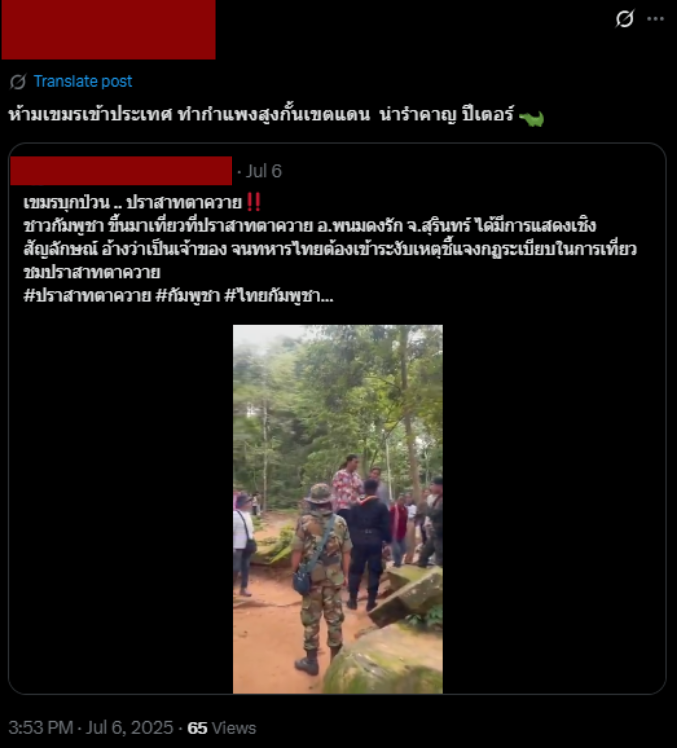
- Cambodia issued a statement condemning the disturbance at Prasat Ta Kwai, accusing Thailand of acting aggressively.
- 7-8 July
- Thailand's Ministry of Culture clarified reports circulating on social media alleging that Cambodia's proposed submission of "Traditional Khmer Wedding" to UNESCO's Intangible Cultural Heritage list would incorporate or reference "ชุดไทย (Chud Thai)," Thailand's traditional national dress. The ministry confirmed, after reviewing Cambodia's submission documents, that no such reference to Chud Thai appeared in the proposal. It also reaffirmed that Thailand was preparing its own nomination of "Chud Thai" for UNESCO recognition as intangible cultural heritage, with the nomination set to be considered by UNESCO's Intergovernmental Committee in 2026.
The exploration of posts during this period found that daily posting volume tracked the rise and fall of public interest in the border issue. The period between June 26-29 recorded the highest volume, with June 27 marking the peak at 6,475 posts, coinciding with a dense cluster of significant developments spanning security, economic, and policy communications from leaders on both sides. Volume then declined steadily after July 3, particularly during July 5-7, when daily posts fell below 2,000, before stabilizing at similar levels through July 9.
Comparing daily post volume against the event timeline shows that the early part of the collection period (June 26-29) coincided with intense activity from both the Thai and Cambodian governments, including border management measures, political positioning, exchanges over sensitive issues such as border trade and territorial claims, psychological warfare, and mobilization through the "United Land Force to Protect Thai Sovereignty" protests. Posting volume then gradually declined in the latter part of the collection period.
The declining trend in post volume between July 3-9 may reflect a gradual de-escalation of tensions. During this period, positive signals emerged from both sides, including the start of official-level talks, increasingly positive political signaling, openings for bilateral dialogue, and formal diplomatic communication with the international community. These developments likely helped reduce the intensity of online reaction, reflecting a shift from a period of heightened tension toward a degree of restored control over the situation.
The exploration of Batch 3 data found that the narratives could still be grouped into the same 10 main topics identified in previous batches, reflecting the continuity of the central issues driving online discussion. The details are as follows.
Emerged Topics
- Domestic Politics
- Discussions in which the border dispute or Thailand's relations with Cambodia are used to criticize or discredit political opponents within Thailand.
- Life and Humanity
- Discussions concerning the value of human life, livelihoods, everyday well-being, and the social and economic conditions of communities living along the Thailand–Cambodia border.
- Militarization
- Discussions related to military activities, including troop deployments, fortification of positions, border patrols, military confrontations, armed clashes, and the use or threat of force along the border.
- Sovereignty and Territorial
- Discussions emphasizing the protection of national territory, sovereignty, border demarcation, territorial claims, and the legitimacy of competing claims over disputed areas.
- Identity and Culture
- Discussions involving national identity, cultural disputes, rejection of shared cultural heritage, cultural superiority narratives, or derogatory representations of another nation's culture or identity.
- Retaliatory Measures
- Discussions concerning reciprocal measures adopted by Thailand and Cambodia, such as border restrictions, suspension of electricity and internet services, trade controls, and other state-imposed countermeasures.
- Peacebuilding
- Discussions advocating dialogue, diplomatic negotiations, conflict de-escalation, and non-violent approaches to resolving the dispute.
- Colonial Legacy and Historical Memory
- Discussions referring to historical events and narratives, including colonial-era border demarcation by France and the use of historical memory to justify contemporary territorial claims.
- Legal Mechanisms
- Discussions concerning international legal and diplomatic mechanisms, including the International Court of Justice (ICJ), the Joint Boundary Commission (JBC), the 2000 Memorandum of Understanding (MOU 2000), and bilateral negotiations.
- Pro-War and Call for Violence
- Discussions expressing support for military action, armed retaliation, or the use of force to resolve the dispute.
The topic of Domestic Politics appeared in the highest proportion during the data collection period, clearly reflecting how the Thailand-Cambodia border tension was linked to domestic Thai political dynamics. Sustained criticism of the Thai government's handling of the situation and its overall stance was observed, particularly around sensitive issues such as the Preah Vihear Temple dispute and references to the 2000 Memorandum of Understanding on the Survey and Demarcation of the Land Boundary, commonly known in Thailand as "MOU43." While the Thai government maintained that resolving the border dispute must proceed through bilateral negotiation in accordance with international law, critics of the government interpreted this stance as a form of concession to Cambodia that risked undermining Thai sovereignty.
Debate also emerged over reports that boundary markers and the demarcation line near Prasat Ta Muen Thom appeared to have shifted on Google Maps from the Thai side to the Cambodian side. This fueled nationalist narratives calling on the Thai government to take a firmer stance in defending national territory. Cultural issues were similarly drawn into domestic political discourse, such as Cambodia's proposal to nominate its traditional wedding ceremony for UNESCO recognition.
The topic of Life and Humanity accounted for nearly one-quarter of all content during the data collection period, reflecting the vulnerability of people directly affected by the border situation and shifting emotional currents online that fluctuated with fear, anger, and anxiety. One clearly identifiable sub-topic was the expression of hatred, stereotyping, and the use of violent, dehumanizing language directed at Cambodians.
The topic of Sovereignty and Territorial accounted for 8.62% of all posts. Many posts showed users clearly rallying around nationalist sentiment, calling on people to "ปกป้องแผ่นดินไทย" (protect Thai land), particularly regarding issues tied to the border. Posts also called on the state to take a firmer stance and attacked opponents who were perceived as conceding too much to Cambodia.
The topic of Militarization during this data collection period was not confined solely to the border situation itself, but permeated deeply into domestic political discourse, particularly following the leak of a private phone call between Prime Minister Paetongtarn Shinawatra and Cambodia's Hun Sen, released by the Cambodian side. The leak sparked widespread suspicion among the Thai public and political circles, leading to questions over the Prime Minister's legitimacy and the Constitutional Court's order for Paetongtarn to suspend her duties pending its ruling.
The topic of Retaliatory Measures showed that online conversation was not confined to debates over official government measures, but was also expressed through the emotional tenor of users' discussions, particularly as cultural heritage issues moved to the forefront, such as the repatriation of 20 Cambodian artifacts and the dispute over Cambodia's UNESCO wedding tradition nomination.
The topic of Peacebuilding, while appearing in a relatively low proportion, carried meaningful significance as a space for de-escalation efforts. Content included field visits by the Commander of the Royal Thai Army's Second Army Region to boost morale among border officials, the delivery of relief supplies from Thailand to Cambodia, and temporary easing of cross-border vehicle restrictions.
The topic of Identity and Culture emerged out of events tied to border control measures, such as discussions of Thailand cutting electricity and internet access to Cambodia, as well as narratives linking the border region to transnational crime, such as call center scam operations.
The topic of Legal Mechanisms reflected efforts by both the government and the public to manage relations through bilateral institutional channels, such as the Joint Boundary Committee (JBC). It also included comparisons drawn between the Thailand-Cambodia situation and other international conflicts, such as the Russia-Ukraine war and the Israel-Palestine conflict.
The topic of Colonial Legacy and Historical Memory included discussions on escalating the dispute to the international stage, such as references to the International Court of Justice's ruling on the disputed area surrounding the Preah Vihear Temple, as well as legal obligation issues, such as the repatriation of ancient artifacts to Cambodia.
The topic of Pro-War and Calls for Violence included some movements leaning toward supporting the use of force or hardline approaches to the border dispute. Of particular concern, a subset of posts called for political change through undemocratic means, such as references to a "ยึดอำนาจ" (seizure of power) or "รัฐประหาร" (coup). While a minority of the overall content, these posts constituted hate speech carrying clear intent toward violence.
Sentiment Distribution
The sentiment distribution within the dataset from June 26 - July 9, 2025 showed an overall tendency toward relatively high negative sentiment. Posts classified as Negative made up more than 57.85%, reflecting dissatisfaction, distrust, and even hostility within the online space during this period. Neutral posts accounted for 33.74%, while only 8.41% expressed Positive sentiment, typically related to encouragement, cooperation, or hope for a peaceful resolution.
Sentiment Distribution by Topic
When breaking down sentiment distribution by topic, clear differences emerged across categories. The topic with the highest share of negative posts was Identity and Culture (64.46%), followed by Domestic Politics (63.78%) and Life and Humanity (57.35%). All three topics reflected perceptions of conflict, cultural threat, fragility of identity, and distrust toward political mechanisms.
By contrast, the topic with the highest share of positive posts was Peacebuilding (17.36%), linked to the promotion of peace, cooperation along the border, and humanitarian efforts. Notably, although the topic of Pro-War Sentiment and Calls for Violence recorded a relatively high Positive share of 14.93%, closer examination of the underlying content revealed that a portion of these Positive posts actually reflected support for hardline postures or militarist ideas.
Meanwhile, Militarization and Sovereignty and Territorial Integrity, despite relatively moderate negative shares (40.31% and 38.26% respectively), still reflected public concern and close scrutiny of the military's role in domestic politics. Notably, Legal Mechanisms had the highest share of neutral posts among all topics, at 89.86%.
Hate Speech Distribution
- TYPE 1
- Cursing with vulgar words, insulting intelligence, and creating otherness
- TYPE 2
- Doxing and harassment, and intimidation
- TYPE 3
- Stereotyping, labeling, devaluing, dehumanizing, and demonizing
- TYPE 4
- Discrimination
- TYPE 5
- Incitement, glorification, support, legitimization, and representation of violence
Following the sentiment analysis, negative posts emerged as the largest category, totaling 24,931 posts. A closer examination of this group through the lens of hate speech found that a large number of posts contained language reflecting hatred or hostility in various forms, classified into five categories.
Type 1 (Cursing, Insulting Intelligence, Otherness) accounted for 74.51% of all posts classified as hate speech, reflecting a state of anger and hostility, with emotion functioning as the primary driver of online communication.
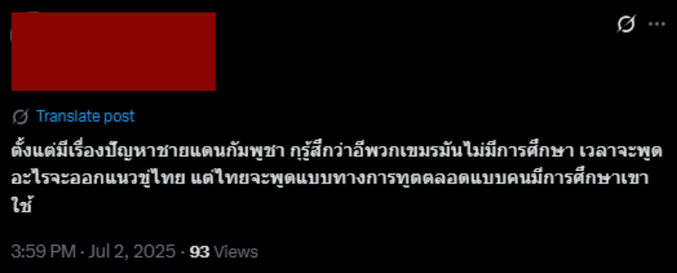
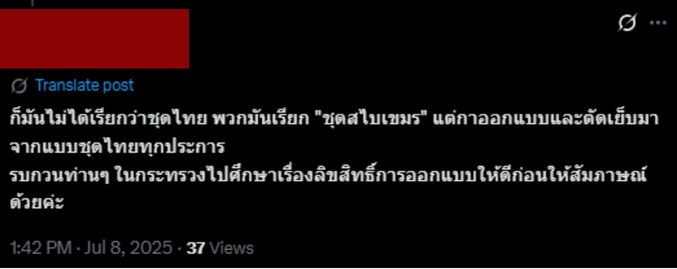
Type 3 (Stereotyping, Labeling, Dehumanizing) followed at 21.87%, pointing to a deeper process of enemy construction that went beyond the use of vulgar language, extending to the structural degradation of the targeted group's worth, such as referring to Cambodians as "beggars."
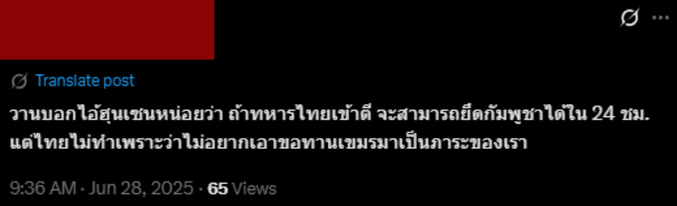
Type 2 (Harassment, Doxing, Intimidation) appeared at a very low share of just 1.06%, and Type 4 (Discrimination) accounted for only 2.21%, most commonly appearing in posts proposing measures such as "banning Cambodians from entering the country" or "stripping migrant workers of their rights." Type 5 (Incitement, Glorification of Violence), considered the most severe level involving explicit support for violence, appeared in only 0.35% of posts.
In summary, the concentration of hate speech in Types 1 and 3 points to a distinctive pattern of communication within this conflict crisis, in which anger and the construction of an enemy image serve as the primary mechanisms driving public sentiment. This pattern warrants particular attention in the development of tools or approaches for early warning systems aimed at detecting the escalation of violence in online spaces.
Top 10 Account by Post Count
In analyzing the behavior of highly active users within the dataset, the online conversation network was driven by both mainstream media accounts and general users. Among the accounts with the highest posting volume, most were media outlets, such as @PPTVHD36, @ThaiPBSNews, @MatichonOnline, @thaipost, and @naewna_news, which continuously reported on developments, with most of their content carrying a neutral tone. At the same time, general user accounts such as @xixxxx and @Nuxxxx also posted at high volume, with content reflecting strong personal emotion and opinion, particularly @Nuxxxx, who appeared across multiple tables simultaneously.
Top 10 Account with Most Mentions Other
Considering the accounts with the highest frequency of mentioning other users, namely @Nuxxxx, @mexxxx, @boxxxx, and @Gixxxx, this group of users appears to consistently function as network builders, drawing others into ongoing conversations, or as catalysts driving interaction within the digital space.
Top 10 Account by Sentiment
In terms of sentiment, several general user accounts emerged as producers of high volumes of negative content, such as @Nuxxxx, @ekxxxx, and @Gixxxx, with negative posts accounting for 10-15% or more of their content. Meanwhile, media accounts such as @ThaiPBSNews, @MatichonOnline, and @PPTVHD36 continued to maintain a predominantly neutral tone. Accounts with a high share of positive content tended to focus on messages of encouragement, calls for peace, or support for a conciliatory stance.
You can view the interactive dashboard at neomomentum.co/c-map